This article appeared in a previous issue of Renew Magazine. I have republished the article here with permission from the publisher.
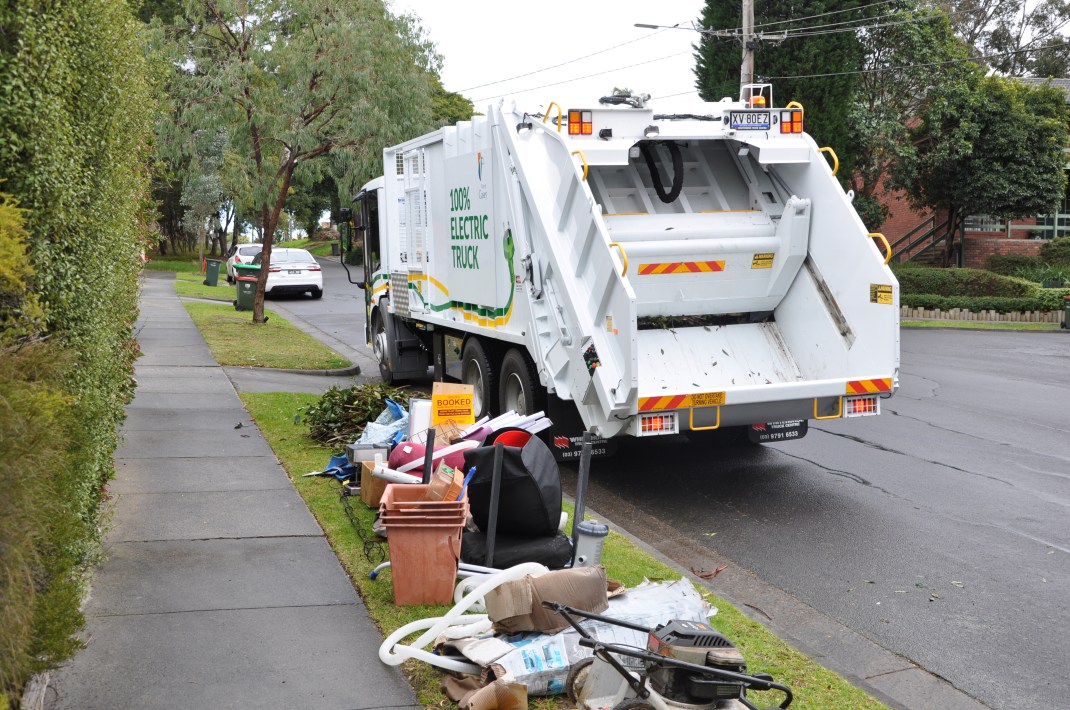
It’s a sight of Australian suburbia as familiar as the eucalypt: piles of unwanted household items littering the nature strip. While the frequency and nature of these hard rubbish collections varies from council to council, nowadays it is understood to be more or less an entitlement of homeownership.
Everything from functioning fridges to widescreen televisions, bedside tables and car tyres, Australia’s hard rubbish collection system is burned into our culture as a convenient way of getting rid of awkward items we no longer require that aren’t suited for the kerbside bin – so much so that a subculture of salvaging items for reuse is common practice.
But herein lies a central issue with the way in which we view these collections, because if scavenging unwanted goods from your neighbours supposed ‘waste’ pile is so straightforward, have we lost sight of the reason this system was created? And if so, can we change the way we view hard rubbish?
How does the system work?
Of course, it is essential to have options for waste disposal. According to the federal government’s latest national waste report, local government and household waste weighed in at 14 megatonnes in the 2020-21 financial year, or, if we look at our country’s entire waste production for that period, it works out to be just under three tonnes of waste per person.
Michael Strickland has been in the business of hard rubbish collection for the past 25 years. As a project manager for WM Waste Management Services, he and his team have contracts to collect from 16 council areas, mostly in Melbourne but also in regional areas such as the Latrobe Valley.
In the two and a half decades he’s been in the work, Michael admits the job has remained mostly unchanged, except for the arrival of new regulations in the collection and disposal of items such as e-waste and tyres. The most common items are everyday household things, but that’s not all that makes the pile.
“I’ve heard of all sorts of things like a coffin has been found [in hard rubbish], and we get heaps of mannequins as well,” he said.
The majority of councils in Victoria now work under a system of hard rubbish bookings where homeowners can book one or two collections per year. Area-wide services are also used in a handful of council areas, but these are becoming less common. Michael’s team is then called out to the location with a compactor truck and a tray truck. The tray truck is used in the context to collect salvageable items, but despite what some might think, Michael says this does not apply to any item that could be repurposed.
“Most things get compacted, it’s only if we’re not allowed to compact them that we don’t compact really,” he said. “The tray truck would pick up things like fridges or e-waste – everything else would go into the compactor truck.”
There are exceptions to this, with some councils offering services for separate mattress and tyre collections, but everything else, no matter whether it’s in good condition, is crushed on the spot.
Michael says it’s a frustrating aspect of his work seeing so many perfectly good items destined for landfill. “Once it’s out in hard rubbish like there’s not a lot of stuff we can salvage and reuse,” he says. “If you thought it was valuable, then why are you putting it out on the street? We’re sort of the last resort, really.”
But rather than operating as a last resort, hard rubbish is used as a means of getting rid of anything. The ABC’s War on Waste series found that 85 per cent of furniture left for kerbside collection is not recycled.
Dr Trevor Thornton is a senior lecturer in hazardous materials management at Deakin University. As well as previously working with Victoria’s Environment Protection Authority, he has studied waste management strategies both here and abroad.
In the early 20th century, collection services were limited to specific items such as empty beer bottles and scrap metal. Landfill sites were less regulated and it was common for families to drop off items and even scavenge directly from these piles. Dr Thorton says once kerbside recycling was introduced in the 1980s and regulations around tip sites tightened, the creation of the hard rubbish collection process we see today arrived as a natural progression.
While these changes made it more convenient for people to dispose of things, by removing ourselves from the process, it also fundamentally changed the ways in which we view waste management.
“We’ve made it easy for people just to get rid of things without thinking of the quality of it,” Dr Thorton says. “Landfill space is quite valuable and we’re running out of it. I guess we’ve been fortunate in Australia, we don’t have the population densities of Europe and America.
“That’s the mentality I think in this country that, yeah, I’d love to recycle, but it’s easy for me just to get somebody to come and pick it up and take it away.”
The Taiwan example

Filling the gaps
While hard rubbish collection appears rooted within the function of local councils, there are efforts happening beneath the level of government to improve standards. In Melbourne’s inner northern council area of Darebin, community member Jo Press was compelled to make changes when she saw a compactor truck in action in 2019.
“It was a little disconcerting, because hard rubbish is meant to be rubbish, you know, of no use anymore,” she says. “When I saw these things being crushed I realised that was actually what happens, so I just felt I had to do something, that this was terrible.”
Jo teamed up with fellow Darebin resident Jackie Lewis, and in 2020, created the Facebook page Darebin Hard Rubbish Heroes. The idea was that instead of subjecting reusable things to the kerbside where they could be crushed or damaged by the weather, instead individuals could post items they no longer needed and have them collected directly.
The page took off immediately, with upwards of 1000 followers in the first week and today more than 22,000 total.
“When we started we saw there was a real need for helping people rehome things, because there’s a lot of barriers,” Jo says. “Some people don’t drive, some people have mobility issues and they can’t lift and move stuff. People accumulate a huge amount of stuff in their lives, and I am living proof of it. It’s just kind of part of being human in a wealthy country.”
During Melbourne’s stretch of strict COVID-19 lockdown measures, members of the group would livestream themselves walking down the street and identifying decent items and even helping to deliver them directly to people’s homes.
Now incorporated as a charity with a core of nine committee members, the group has expanded its remit. They’ve run repair workshops, created a recycling hub for harder to recycle items like blister packs and bottleshops, and even run their own trash and treasure pop up shops. The largest of these came last year, when Jo and the team were able to utilise a council grant to rent out a former garage space to house and resell all sorts of found household items. In a three month period, the group collected a total of 13 tonnes of otherwise useful things.
In 2020, not long after Darebin Hard Rubbish Heroes was founded, the team created a survey for its members and received 664 responses. They found that a third of all respondents had only learnt in the past 12 months that most things placed out for hard rubbish would be crushed.
Jo says the survey data points to the most important lesson she’s learnt while attempting to improve sustainability outcomes in her neighbourhood.
“I think the biggest thing is in educating people,” she said.
“There’s always going to be a group of people that will do stuff, and there’s going to be a group of people that will never. But there’s a huge group in the middle.”

Finding a balance
Even as someone deeply committed to living a more sustainable lifestyle, Jo admits that waste management is a naturally complex issue. “I still, almost every day, ask myself: can this go in that bin?” she says. “So think of all those people who don’t know a lot. They’re going to be having even more struggles too.”
Although she’s spent the past few years addressing the misuse of hard rubbish, Jo still sees it as an important cog in Australia’s waste management system.
So rather than doing away with it completely, she argues that councils and community groups like Darebin Hard Rubbish Heroes can be the cog that informs people to make better decisions.
And there are other community services and policy suggestions that are working toward the same aim. In 2021, the federal government’s productivity commission released a report with recommendations to strengthen the right to repair. In essence, the report found there are too many barriers created by companies to extend the usability of products, which in turn is exacerbating costs and issues of waste and e-waste management.
Thornton says this also created a push for product stewardship schemes, where large companies that sell items like televisions and furniture are required to also provide a recycling service for those items. “I think that’s something that we need a lot more of, you know, if you sell it, then you’ve got some responsibility to ensure that there is a system in place,” he says.
Since 2015 repair cafes have started to pop up across the country, with 13 in Melbourne alone. These local organisations provide a free repair service for all sorts of household goods, such as electronics, bikes, clothing and furniture.
On a personal level, Jo’s home is testament to her reuse mindset. In her courtyard there is a small circular outdoor table, salvaged from a neighbour’s nature strip and resprayed with an orange finish. In her living room she is working on a new coffee table, which will feature an analog clock face serving as the table face fixed to a set of old chair legs. Most of all she’s appreciative of the ways in which the local repurposing collective has connected herself and others to their own community in a practical and meaningful way.
“There’s a lot of stories o”f people who’ve been in situations where they’ve found the support of the group,” she says. And yeah, a lot of people who have connected through the group, which is kind of amazing. I can’t say it’s restored my faith in human nature because I always have felt people were good, but it doesn’t hurt at all.”
 Oliver Lees 李奥力