
This article appeared in issue 172 of Renew Magazine, published in July 2025. I have republished the article here with permission from the publisher.
It’s no secret that right now Australia’s environment is under immense strain. Biodiversity Council Australia is clear in its assessment: we are facing a biodiversity crisis.
Australia is one of only 17 nations globally considered to be megadiverse, meaning much of this life is unique to Australia. In the fight to preserve some of the most at-risk life on Earth, we carry a disproportionate responsibility, and right now we are failing. Decades of industrialised resource extraction, the deleterious effects of climate change, and a lack of forward-thinking government policy has enabled the problem to fester.
But rather than submit to this bleak state of affairs, people are taking matters into their own hands. Through innovative local projects, native planting and expansive rewilding projects, a grassroots biodiversity movement has been growing steadily, one that might hold the key to fundamentally reshaping the way we consider our relationship to nature.
Our conservation context
A further look at the research underpinning Australia’s biodiversity context makes for grim reading.
Last year alone, 41 species of flora and fauna were added to the threatened list, which in total features more than 2000 names.
But there is another set of statistics worth mentioning here. Each year, Biodiversity Council Australia surveys the public’s feelings toward conservation. A staggering 96 percent of people agree that more needs to be done to protect the environment, with waste and pollution, extinction of native animals and the loss of natural places at the top of the list of concerns.
Biodiversity Council member and professor Sarah Bekkesy from RMIT University is hopeful a shift might be underway. She is among a large cohort of environment advocates that is asking the federal government to contribute one percent of its budget toward nature. She says the data provides a clear mandate for greater environmental protection.
“It shouldn’t be an ideological topic. So much of our economy is dependent on nature and having healthy environments,” she says. “It’s actually making sure that we are healthy, because our own health is so intrinsically linked to having doses of nature and experiencing nature and having a clean environment.”
On an individual level, Professor Bekkesy says it pays for people to consider their spending and consumption habits. Simple changes like avoiding eating non-sustainably harvested fish, eating less red meat and even purchasing sustainable pet food options can have a big impact.
So too are the big choices, like where you choose to live and how that home is made.
“Your choice of housing is one of the most significant things that you can do for biodiversity,” she says. “About a quarter of the economic activity impacts on biodiversity negatively is in the construction industry.”

Hollow… is it tree you’re looking for?
On a dry paddock in the north-eastern suburbs of Melbourne, an arborist is halfway up a towering gum tree using a specialised power tool called a Hollowhog. His mission is not one of destruction. In fact, his work will bring more life to the environment. He uses the Hollowhog to drill where a hollow has started to develop, doing so carefully so as not to damage the tree’s living tissue while creating a habitat that can be used by wildlife.
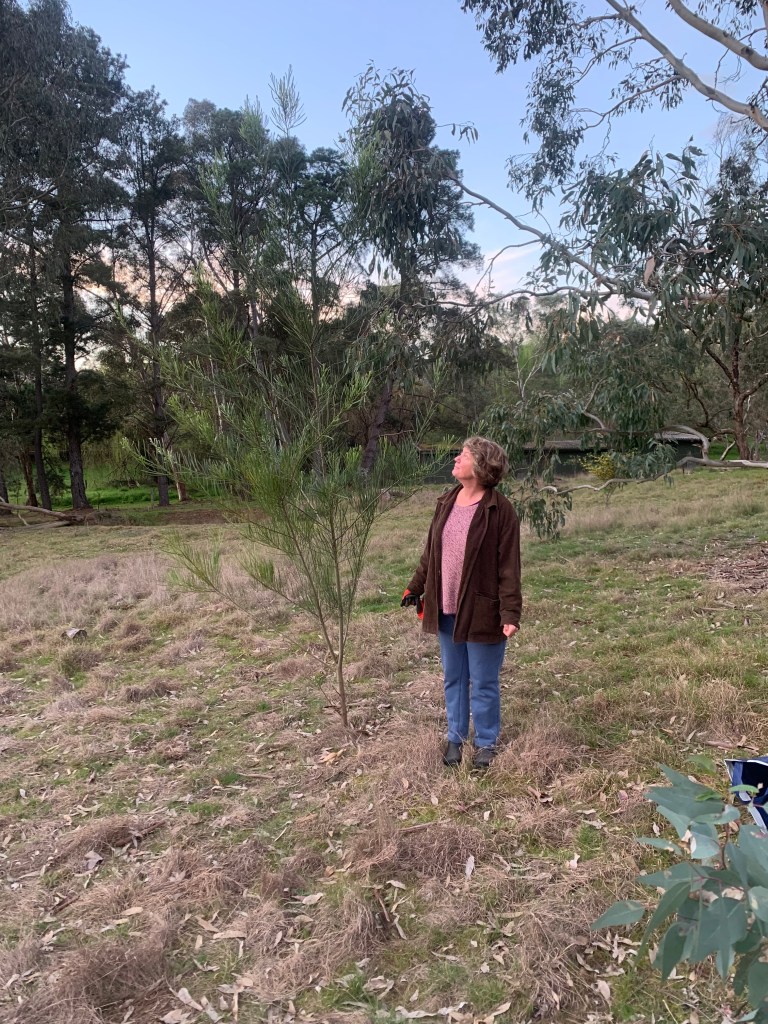
This effort has been spearheaded by retiree Judith Venables, who has poured much of her free time into finding ways to help local wildlife and the environment. I should know, because I am her son. Our family home is on a five-acre property in Lower Plenty. Due to planning restrictions from the last century, many of the homes in the neighbourhood, ours included, are unable to subdivide, leaving them with mostly empty paddocks that are seldom used.
Hoping to rectify that in some way, Judith set about planning her local tree hollow project.
“I realised walking around the neighbourhood that there were lots of old gums where this technology could be useful,” she says.
“Given the loss of habitat and the loss of large trees that are suitable for hollow dwellings, I thought that I might be able to get an environmental grant so that this work could be carried out around the neighbourhood.”
Her local council backed the idea, with a $10,000 grant to employ three arborists to work over three days. She did the legwork herself: knocking on neighbour’s doors to ask if she could take a look at their trees.
In total, the arborists worked on six large gum trees, resulting in the formation of 43 new hollows.
A few holes in a tree might seem insubstantial, but the loss of these habitats across the landscape is one of the major challenges threatening species. Nest boxes can also be useful, but not all creatures are willing to use them. Some 300 species of Australian animals depend on these environments, and often move between them with regularity.
In The Forest Wars: The Ugly Truth About What’s Happening In Our Tall Forests, internationally renowned forest expert professor David Lindenmayer describes his seminal research tracking the Mountain Pygmy Possum from 1990 to 1992.
“The results are extraordinary… I discovered that each possum moves regularly from one tree to another. Over a year and a half of tracking, I found that an individual possum might use more than a dozen different trees. Our research has shown clearly that the way animals use large old trees is far more complicated than anyone ever thought.”
The extremely slow pace of hollow development and the significant clearing of old growth trees are the major factors making life harder for animals like the Mountain Pygmy Possum, which is critically endangered.
Mum’s grant also helped fund the purchase of two motion-activated cameras that capture any new life checking out these new spots. Already, the signs are promising.
“So far there’s been a lot of interest from rainbow lorikeets, also quite a bit of eastern rosella interest,” she says. “There’s been brushtail possums and ringtail possums. It’s lovely, I get the photos sent through to my email and it’s always good to see who’s checking it out.”
Gardening for wildlife
As Biodiversity Council Australia’s report indicates, people want to see native environments restored. According to their survey, 86 percent of respondents were concerned about the loss of native plants and animals.
One group that was created to help turn this sentiment into action is Gardens for Wildlife. Since 2006, the organisation has been visiting homes and advising homeowners on what they can do to make their backyard more welcoming to wildlife.
The concept was developed by Jan Jordan, who had developed her own butterfly garden and was determined to protect it. When her attempt to seek assistance from the state government for her project failed, she recognised there was a gap in the market for people like her who wanted to do more but didn’t know where to start.
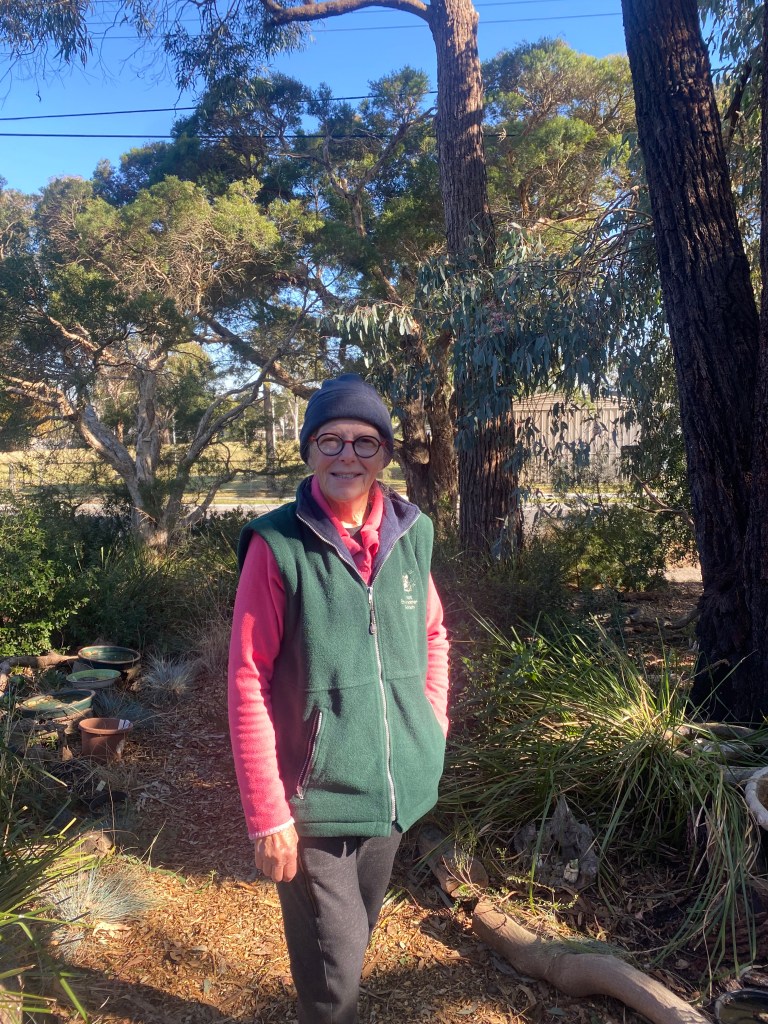
I met Irene Kelly, one of Jan’s earliest collaborators, at her home in an outer eastern suburb of Melbourne. She greeted me with a jar of homemade loganberry jam. As the current president of Gardens for Wildlife, she remembers Jan coming to her with the idea.
“I thought oh my god, this is absolutely what we need,” she says. “We need people not only to be doing it on their own property but to trigger something in them that makes them aware that it’s valuable. Knowledge is everything, people will do something if they know how to.”
Over two decades, the idea has flourished. Gardens for Wildlife now has backing from 22 council areas in Victoria, with a further 27 councils considering the program. The process is simple; residents within a participating council can register their interest. Two volunteers then attend the property to check out and listen to what they’d like to achieve and advise them on the best mix of flora to make it happen.
Irene says while they are there to provide instruction, consultation is a crucial part of the process.
“It’s very important that I know what they’re interested in because what’s the point of me going in and telling them they should have this, that and the other in their garden, when they may not want those things,” she says.
“It’s that personal connection that our own research has shown us makes a huge difference.”
More than 1,600 participants have now had the Gardens for Wildlife treatment, and the organisation has no plans of slowing down. Earlier this year Kelly flew to New South Wales to train a new team of guides. With one program now operational there, the organisation has recently adopted Gardens for Wildlife Australia, with a plan to roll the initiative out across the country.
Professor Bekkesy says this work in urban areas is just as crucial as efforts to save remote landscapes.
“The most critically endangered ecosystems in Australia are on the edges of Melbourne, Brisbane, Sydney, Perth. It’s not actually a trivial thing to be part of trying to save species in the suburbs.”
After our conversation, Irene took me on a tour of her own front garden. When she and her husband purchased the property in the 1970s, they started their own journey of understanding what a native garden might look like.
I counted at least six bowls suitable for bird bathing dotted around the space. She pointed out the lomandras and the correas planted to attract butterflies, and the prickly thickets suitable for small birds.
The understory was complimented by a large gum, and we paused for a moment to locate the musk lorikeet happily chirping above our heads.
“When I walk around the garden, I really associate myself with that joy that you get out of seeing a new plant grow or flower,” she says.
Forging new forests
When it comes to biodiversity, forests are the richest environments we have. But since colonisation, Australia’s forests have been decimated by forestry practices. Professor David Lindenmayer uses this example to illustrate the point in his aforementioned book on Australian forestry.
“At the time of British invasion it would have been possible to walk the roughly 1,500 kilometres from Melbourne to Brisbane through almost continuous temperate woodland,” he wrote.
“Now, 95-99 per cent of that woodland is gone… cleared for cropping and livestock grazing, with the vast majority of remaining patches smaller than one hectare.”
In one study, professor Lindenmayer found that places proposed for logging in Victoria in 2019 were important habitats for approximately 50 of the state’s most threatened species.
Despite the fact that native logging continues in many parts of the country, there has also been a collective awakening to the crucial role these environments play.
There is a growing expectation that businesses and individuals should be mindful of their carbon emissions, thus driving them to invest in reforestation efforts. Greenfleet is one organisation that plants native, biodiverse forests to help its clients offset their carbon impact.
Working on a minimum of five hectares, Greenfleet engages a landholder to revegetate a space, which is often unused former farming land. They then enter into a 100 year agreement, which allows them access to maintain and protect the forest as it develops.
Greenfleet’s revegetation general manager Alex Paddock says the organisation’s work is attempting to undo some of the harm done to the environment.
“Various approaches and government policies in a lot of cases in the past have led to what I think is dramatic over-clearing and a total lack of balance in the landscape,” he said.
“There are many areas in Australia where you can look from one horizon to another and not see any native ecosystems.”
Forest ecosystems are complex and can take many years to develop. In 2023, Greenfleet revisited a forest in Noosa they’d planted 20 years earlier to see what kinds of changes had been made. They spent the day walking through the space, documenting what they say. A total of 43 new species had made a home in the fledgling forest. Acacias, banana bushes, broadleaf brambles and palm lilies, just to name a few. Greenfleet conducts its planting in rows, but over the two decades those rigid lines have dissolved, making way for a more natural sprawl.
Mr Paddock says the findings are significant. “We get birds and other creatures that are bringing with them seed and new species from other forests surrounding that site and those species are now growing in our forests,” he says.
“It’s an example of how biodiversity and forest ecosystem processes can develop much more complexity if given the opportunity.”
Tomorrow’s habitat
Back at Mum’s place, we’re on our hands and knees placing natives in the soil.
As well as the tree hollow project, she is also three years into constructing a wildlife corridor that she hopes will bring new life to one of the paddocks on the property. This has meant planting hundreds of native trees, bushes and shrubs, and carving out swales to help the flow of rainwater to a wetland at the bottom of the property.
The progress has been slow; many hours of digging into the clay-hardened earth and constructing tree guards to ward off the pesky rabbits. The wetland is now our most regular topic of conversation. The family group chat is populated by previously unlikely animal sightings, such as mobs of kangaroos, frogs and even an echidna.
As we’re finishing up the afternoon’s planting, she points to a diminutive gum planted earlier that week.
One day with a bit of luck, she tells me, it will grow to be as big as the fellow gums in the paddock, which have been there for centuries.
Not in my lifetime, she clarifies. But I can tell that doesn’t bother her.
 Oliver Lees 李奥力